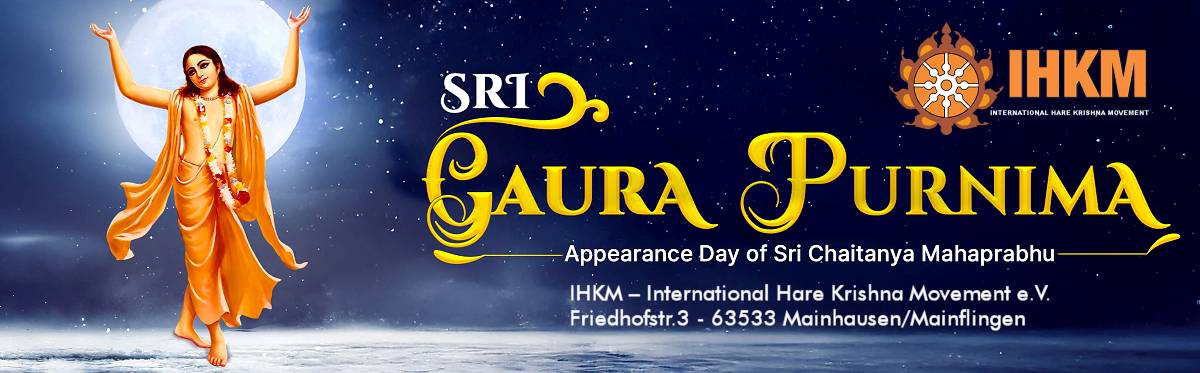
Gaura Pūrṇimā – March 3, 2026 – The appearance day of Caitanya Mahāprabhu
The appearance day of Śrī Caitanya Mahāprabhu, Gaura Pūrṇimā, is celebrated on the full moon day in the month of Phālguna (February/March) and falls this year 2026, on March 3.
Gaura Pūrṇimā is the most important day in Vaishnavism and commemorates the appearance of Śrī Caitanya Mahāprabhu, who is worshiped as the embodiment of love and devotion to Krishna.
On the appearance day itself, the devotees will be on book distribution, and in the evening there will be a small program with Ekādaśī-Prasādam, Kīrtan and a reading about the glorious deeds and pastimes of Caitanya Mahāprabhu. The main celebrations will take place the following Sunday, March 8, 2026. Everyone is cordially invited to both events.
INVITATION
On Sunday, March 8th 2026, we will celebrate Gaura Pūrṇimā in our temple in Mainhausen. The festivities start at 4:00 p.m. Everyone is welcome and warmly invited. We look forward to seeing you!
We will celebrate the appearance day of Lord Caitanya Mahāprabhu with Abhiṣeka (bathing ceremony of the Deity) and Ārati (light ceremony). In addition to ecstatic mantra chanting (kīrtan) and a delicious feast (prasādam), there will be a reading about the glorious deeds of Caitanya Mahāprabhu.
Programm:
Sunday, March 8, 2026, starting at 4:00 p.m Kīrtana: Singing sacred mantras together Lecture: Gaurāṅga’s pastimes and deeds and the significance of his appearance Prasādam: Festive vegetarian prasādam meal
The Appearance Day of Gaurāṅga
(Śrī Caitanya Mahāprabhu)
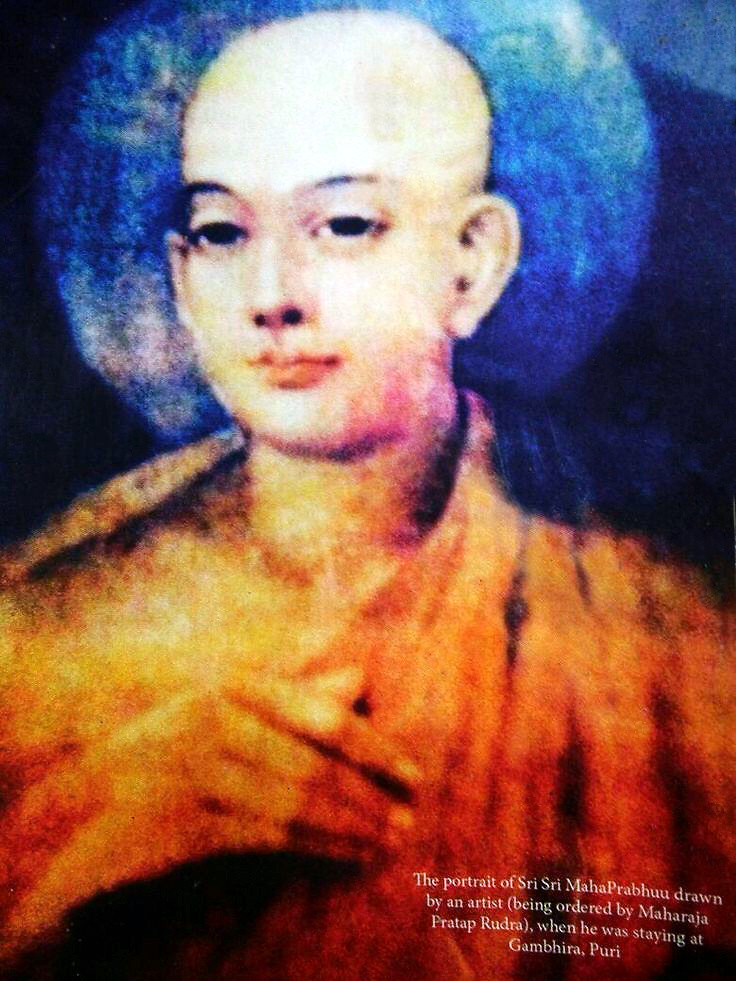
Śrī Caitanya Mahāprabhu, also known as Gaurāṅga, appeared in 1486 in Navadvīpa (now West Bengal, India), as the son of Śrī Jagannath Mishra and Śrīmatī Sachidevi. His parents named him Nimāi because he was born under a Nimba (neem) tree in the courtyard of his parents’ house. As the golden incarnation of Lord Śrī Kṛṣṇa, He came to earth in the mood of His devotee, Śrīmatī Rādhārāṇī. Śrī Caitanya Mahāprabhu appeared to propagate the practice of chanting the holy names of God (Saṅkīrtana) and to generously distribute love for God to all living beings.
After his childhood pastimes in Nadia, at the age of 24 he adopted the social order of a wandering monk (Sannyāsa) and traveled through large parts of India, especially to Jagannath Purī (Odisha), where he spent most of his life. His followers saw him as a divine incarnation of Kṛṣṇa.
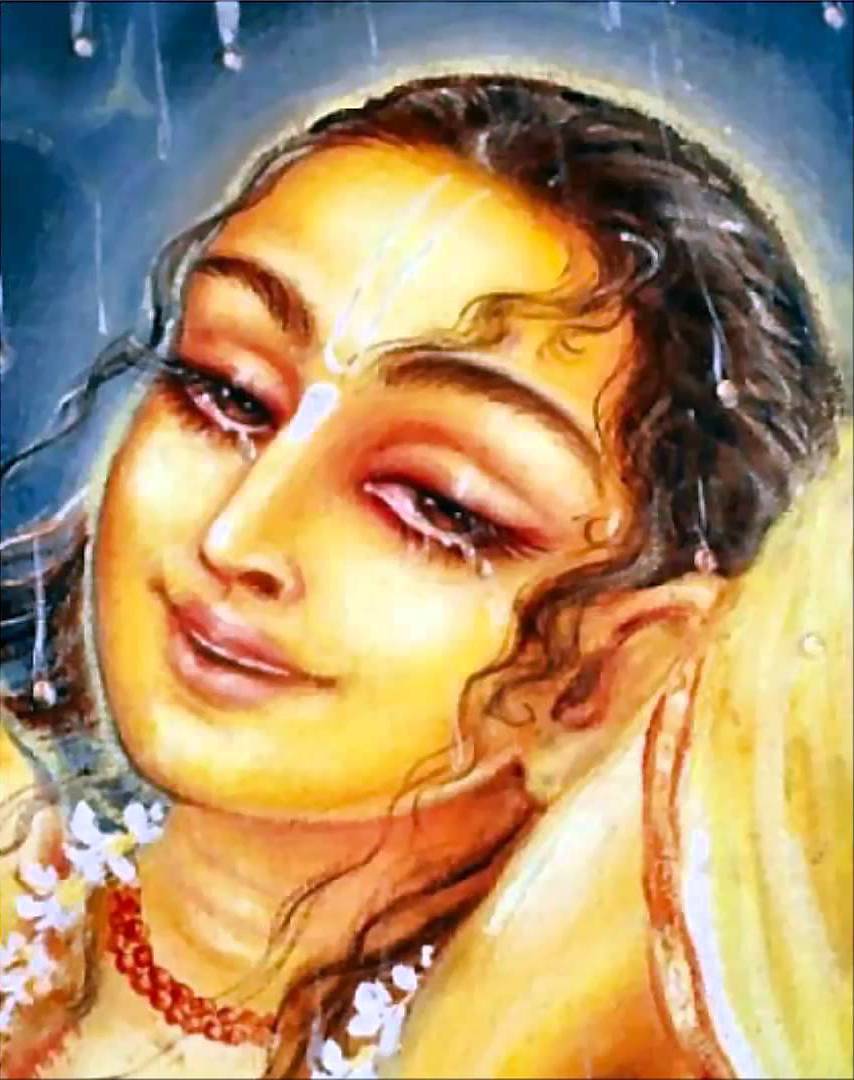
O my Lord, when will my eyes be adorned with tears of love that constantly glide down when I chant Your holy name?
Lord Caitanya Mahāprabhu himself gave us only eight verses, known as the Śikṣāṣṭakam (“Eight Instructions”). These verses reveals his teachings and principles, especially the importance of chanting the holy name of Lord Kṛṣṇa. His teachings and life were passed down and recorded in writing by his disciples and followers.
Original translation
from Caitanya-caritāmṛta Antya-līlā, Chapter 20, Verses: 12, 16, 21, 29, 32, 36, 39 and 47
The Śikṣāṣṭaka Prayers
Simply by chanting the holy name of Lord Kṛṣṇa, one can be freed from all undesirable habits. This is the means of awakening all good fortune and initiating the flow of waves of love for Kṛṣṇa. “By performing congregational chanting of the Hare Kṛṣṇa mantra, one can destroy the sinful condition of material existence, purify the unclean heart and awaken all varieties of devotional service.” (CC/Antya/20/11), (CC/Antya/20/13)
***
– The Eight Instructions of Lord Śrī Caitanya Mahāprabhu –
Cited from Śrī Caitanya-Caritāmṛta, Antya-līlā, Chapter 20, (1975)
cetaḥ—of the heart; darpaṇa—the mirror; mārjanam—cleansing; bhava—of material existence; mahā-dāvāgni—the blazing forest fire; nirvāpaṇam—extinguishing; śreyaḥ—of good fortune; kairava—the white lotus; candrikā—the moonshine; vitaraṇam—spreading; vidyā—of all education; vadhū—wife; jīvanam—the life; ānanda—of bliss; ambudhi—the ocean; vardhanam—increasing; prati-padam—at every step; pūrṇa-amṛta—of the full nectar; āsvādanam—giving a taste; sarva—for everyone; ātma-snapanam—bathing of the self; param—transcendental; vijayate—let there be victory; śrī-kṛṣṇa-saṅkīrtanam—for the congregational chanting of the holy name of Kṛṣṇa.
“Let there be all victory for the chanting of the holy name of Lord Kṛṣṇa, which can cleanse the mirror of the heart and stop the miseries of the blazing fire of material existence. That chanting is the waxing moon that spreads the white lotus of good fortune for all living entities. It is the life and soul of all education. The chanting of the holy name of Kṛṣṇa expands the blissful ocean of transcendental life. It gives a cooling effect to everyone and enables one to taste full nectar at every step.
nāmnām—of the holy names of the Lord; akāri—manifested; bahudhā—various kinds; nija-sarva-śaktiḥ—all kinds of personal potency; tatra—in that; arpitā—bestowed; niyamitaḥ—restricted; smaraṇe—in remembering; na—not; kālaḥ—consideration of time; etādṛśī—so much; tava—Your; kṛpā—mercy; bhagavan—O Lord; mama—My; api—although; durdaivam—misfortune; īdṛśam—such; iha—in this (the holy name); ajani—was born; na—not; anurāgaḥ—attachment.
My Lord, O Supreme Personality of Godhead, in Your holy name there is all good fortune for the living entity, and therefore You have many names, such as Kṛṣṇa and Govinda, by which You expand Yourself. You have invested all Your potencies in those names, and there are no hard and fast rules for remembering them. My dear Lord, although You bestow such mercy upon the fallen, conditioned souls by liberally teaching Your holy names, I am so unfortunate that I commit offenses while chanting the holy name, and therefore I do not achieve attachment for chanting.
tṛṇāt api—than downtrodden grass; sunīcena—being lower; taroḥ—than a tree; iva—like; sahiṣṇunā—with tolerance; amāninā—without being puffed up by false pride; mānadena—giving respect to all; kīrtanīyaḥ—to be chanted; sadā—always; hariḥ—the holy name of the Lord.
“One who thinks himself lower than the grass, who is more tolerant than a tree, and who does not expect personal honor but is always prepared to give all respect to others can very easily always chant the holy name of the Lord.
na dhanaṁ na janaṁ na sundarīṁ
kavitāṁ vā jagadīśa kāmaye | mama janmani jamanīśvare
bhavatād bhaktir ahaitukī tvayi || 4||
na—not; dhanam—riches; na—not; janam—followers; na—not; sundarīm—a very beautiful woman; kavitām—fruitive activities described in flowery language; vā—or; jagat-īśa—O Lord of the universe; kāmaye—I desire; mama—My; janmani—in birth; janmani—after birth; īśvare—unto the Supreme Personality of Godhead; bhavatāt—let there be; bhaktiḥ—devotional service; ahaitukī—with no motives; tvayi—unto You.
“O Lord of the universe, I do not desire material wealth, materialistic followers, a beautiful wife or fruitive activities described in flowery language. All I want, life after life, is unmotivated devotional service to You.
ayi—oh, My Lord; nanda-tanuja—the son of Nanda Mahārāja, Kṛṣṇa; kiṅkaram—the servant; patitam—fallen; mām—Me; viṣame—horrible; bhava-ambudhau—in the ocean of nescience; kṛpayā—by causeless mercy; tava—Your; pāda-paṅkaja—lotus feet; sthita—situated at; dhūlī-sadṛśam—like a particle of dust; vicintaya—kindly consider.
“Oh, My Lord, O Kṛṣṇa, son of Mahārāja Nanda, I am Your eternal servant, but because of My own fruitive acts, I have fallen in this horrible ocean of nescience. Now please be causelessly merciful to Me. Consider Me a particle of dust at Your lotus feet.
nayanam—the eyes; galat-aśru-dhārayā—by streams of tears running down; vadanam—mouth; gadgada—faltering; ruddhayā—choked up; girā—with words; pulakaiḥ—with erection of the hairs due to transcendental happiness; nicitam—covered; vapuḥ—the body; kadā—when; tava—Your; nāma-grahaṇe—in chanting the name; bhaviṣyati—will be.
“My dear Lord, when will My eyes be beautified by filling with tears that constantly glide down as I chant Your holy name? When will My voice falter and all the hairs on My body stand erect in transcendental happiness as I chant Your holy name?
yugāyitam—appearing like a great millennium; nimeṣeṇa—by a moment; cakṣuṣā—from the eyes; prāvṛṣāyitam—tears falling like torrents of rain; śūnyāyitam—appearing void; jagat—the world; sarvam—all; govinda—from Lord Govinda, Kṛṣṇa; viraheṇa me—by My separation.
“My Lord Govinda, because of separation from You, I consider even a moment a great millennium. Tears flow from My eyes like torrents of rain, and I see the entire world as void.
TEXT 47
আশ্লিষ্য বা পাদরতাং পিনষ্টু মা- মদর্শনান্মর্মহতাং করোতু বা ।
যথা তথা বা বিদধাতু লম্পটো মত্প্রাণনাথস্তু স এব নাপরঃ ॥ ৪৭ ॥
āśliṣya vā pāda-ratāṁ pinaṣṭu mām
adarśanān marma-hatāṁ karotu vā | yathā tathā vā vidadhātu lampaṭo
mat-prāṇa-nāthas tu sa eva nāparaḥ || 8||
āśliṣya—embracing with great pleasure; vā—or; pāda-ratām—who is fallen at the lotus feet; pinaṣṭu—let Him trample; mām—Me; adarśanāt—by not being visible; marma-hatām—brokenhearted; karotu—let Him make; vā—or; yathā—as (He likes); tathā—so; vā—or; vidadhātu—let Him do; lampaṭaḥ—a debauchee, who mixes with other women; mat-prāṇa-nāthaḥ—the Lord of My life; tu—but; saḥ—He; eva—only; na aparaḥ—not anyone else.
“Let Kṛṣṇa tightly embrace this maidservant, who has fallen at His lotus feet. Let Him trample Me or break My heart by never being visible to Me. He is a debauchee, after all, and can do whatever He likes, but He is still no one other than the worshipable Lord of My heart.
[END]
***
Phala-Śruti [Result of hearing or receiting Śrī Śikṣāṣṭakam]
(Antya-līlā, Chapter 20, Text 65)
prabhura—of Śrī Caitanya Mahāprabhu; śikṣā-aṣṭaka—of the eight instructions; śloka—the verses; yei—anyone who; paḍe—recites; śune—or hears; kṛṣṇe—unto Lord Kṛṣṇa; prema-bhakti—ecstatic love and devotion; tāra—his; bāḍe—increases; dine-dine—day after day.
If anyone recites or hears these eight verses of instruction by Śrī Caitanya Mahāprabhu, his ecstatic love and devotion for Kṛṣṇa increase day by day.
***
Antya-līlā, Chapter 20, Text 48
.
আমি — কৃষ্ণপদ-দাসী, তেঁহো — রসসুখরাশি, আলিঙ্গিয়া করে আত্মসাথ ।
কিবা না দেয় দরশন, জারেন মোর তনুমন, তবু তেঁহো — মোর প্রাণনাথ ॥ ৪৮ ॥
.
āmi — kṛṣṇa-pada-dāsī, teṅho — rasa-sukha-rāśi,
āliṅgiyā kare ātma-sātha |
kibā nā deya daraśana, jārena mora tanu-mana,
tabu teṅho — mora prāṇa-nātha ||
āmi—I; kṛṣṇa-pada-dāsī—a maidservant at the lotus feet of Kṛṣṇa; teṅho—He; rasa-sukha-rāśi—the reservoir of transcendental mellows; āliṅgiyā—by embracing; kare—makes; ātma-sātha—merged; kibā—or; nā deya—does not give; daraśana—audience; jārena—corrodes; mora—My; tanu-mana—body and mind; tabu—still; teṅho—He; mora prāṇa-nātha—the Lord of My life.
I am a maidservant at the lotus feet of Kṛṣṇa. He is the embodiment of transcendental happiness and mellows. If He likes He can tightly embrace Me and make Me feel oneness with Him, or by not giving Me His audience, He may corrode My mind and body. Nevertheless, it is He who is the Lord of My life.
This website uses cookies — You can find more information about this and your rights as a user in our data-protection. Click “I agree” to accept cookies and be able to visit our website directly. About "Settings" You can activate or deactivate individual cookies.
Wir können Cookies anfordern, die auf Ihrem Gerät eingestellt werden. Wir verwenden Cookies, um uns mitzuteilen, wenn Sie unsere Websites besuchen, wie Sie mit uns interagieren, Ihre Nutzererfahrung verbessern und Ihre Beziehung zu unserer Website anpassen.
Klicken Sie auf die verschiedenen Kategorienüberschriften, um mehr zu erfahren. Sie können auch einige Ihrer Einstellungen ändern. Beachten Sie, dass das Blockieren einiger Arten von Cookies Auswirkungen auf Ihre Erfahrung auf unseren Websites und auf die Dienste haben kann, die wir anbieten können.
Notwendige Website Cookies
Diese Cookies sind unbedingt erforderlich, um Ihnen die auf unserer Webseite verfügbaren Dienste und Funktionen zur Verfügung zu stellen.
Da diese Cookies für die auf unserer Webseite verfügbaren Dienste und Funktionen unbedingt erforderlich sind, hat die Ablehnung Auswirkungen auf die Funktionsweise unserer Webseite. Sie können Cookies jederzeit blockieren oder löschen, indem Sie Ihre Browsereinstellungen ändern und das Blockieren aller Cookies auf dieser Webseite erzwingen. Sie werden jedoch immer aufgefordert, Cookies zu akzeptieren / abzulehnen, wenn Sie unsere Website erneut besuchen.
Wir respektieren es voll und ganz, wenn Sie Cookies ablehnen möchten. Um zu vermeiden, dass Sie immer wieder nach Cookies gefragt werden, erlauben Sie uns bitte, einen Cookie für Ihre Einstellungen zu speichern. Sie können sich jederzeit abmelden oder andere Cookies zulassen, um unsere Dienste vollumfänglich nutzen zu können. Wenn Sie Cookies ablehnen, werden alle gesetzten Cookies auf unserer Domain entfernt.
Wir stellen Ihnen eine Liste der von Ihrem Computer auf unserer Domain gespeicherten Cookies zur Verfügung. Aus Sicherheitsgründen können wie Ihnen keine Cookies anzeigen, die von anderen Domains gespeichert werden. Diese können Sie in den Sicherheitseinstellungen Ihres Browsers einsehen.
Google Analytics Cookies
Diese Cookies sammeln Informationen, die uns - teilweise zusammengefasst - dabei helfen zu verstehen, wie unsere Webseite genutzt wird und wie effektiv unsere Marketing-Maßnahmen sind. Auch können wir mit den Erkenntnissen aus diesen Cookies unsere Anwendungen anpassen, um Ihre Nutzererfahrung auf unserer Webseite zu verbessern.
Wenn Sie nicht wollen, dass wir Ihren Besuch auf unserer Seite verfolgen können Sie dies hier in Ihrem Browser blockieren:
Andere externe Dienste
Wir nutzen auch verschiedene externe Dienste wie Google Webfonts, Google Maps und externe Videoanbieter. Da diese Anbieter möglicherweise personenbezogene Daten von Ihnen speichern, können Sie diese hier deaktivieren. Bitte beachten Sie, dass eine Deaktivierung dieser Cookies die Funktionalität und das Aussehen unserer Webseite erheblich beeinträchtigen kann. Die Änderungen werden nach einem Neuladen der Seite wirksam.
Google Webfont Einstellungen:
Google Maps Einstellungen:
Google reCaptcha Einstellungen:
Vimeo und YouTube Einstellungen:
Datenschutzrichtlinie
Sie können unsere Cookies und Datenschutzeinstellungen im Detail in unseren Datenschutzrichtlinie nachlesen.